

Anxiety Therapy in Chapel Hill, NC
Online somatic therapy for people who live inside their heads — and are ready to feel the difference in their bodies.
Serving Chapel Hill and throughout North Carolina via online therapy.
Chapel Hill runs on performance. And performance has a cost.
There's a particular kind of pressure that lives in Chapel Hill. UNC, the UNC Health system, the medical school, the research infrastructure — this is a community where intellectual achievement isn't exceptional, it's the baseline. Where the people around you are brilliant and driven and doing significant work.
And where anxiety can hide very, very well.
You probably present as capable and together. You meet your deadlines. You produce. You show up for other people. If you're a clinician, you're holding space for patients' pain while quietly carrying your own. If you're a student or researcher, you're navigating the sustained pressure of never quite being finished, never quite being certain your work is good enough.
The anxiety isn't dramatic. It doesn't stop you from functioning. It just runs — constantly, underneath everything — as a low-level hum that makes rest feel impossible and ease feel like something other people get to have.
That is not how you're supposed to feel. And it's not something you have to keep managing.
What anxiety looks like in Chapel Hill, NC
For most of my Chapel Hill clients, anxiety doesn't look like falling apart. It looks like this:
You haven't fully rested — in the way rest is supposed to feel restorative — in a long time
You're good at your work and quietly terrified that at some point people will realize you're not as competent as they think
The internal standards you hold yourself to are significantly higher than any external standard placed on you
You can't turn off work mode even when you're not working
You're a good clinician, researcher, or student — and the empathy or intellectual effort it takes to do that well is quietly depleting you
You've understood your anxiety for a long time. That understanding hasn't made it stop
This last point is critical. Chapel Hill attracts people with high psychological literacy. Many of my clients have read the research, understand polyvagal theory, know their attachment style. They can explain their anxiety fluently. They just can't stop it — because understanding anxiety and resolving it at the level of the nervous system are two different things entirely.
Why insight isn't enough — and what to do instead
If you're well-informed about anxiety, you probably already know that the amygdala doesn't respond to rational argument. You know that the prefrontal cortex goes partially offline under threat activation. You know that chronic stress keeps the HPA axis elevated, that cortisol has downstream effects on sleep and cognition and immune function.
You know all of this. Your nervous system is still dysregulated.
That's not a gap in your knowledge. That's the gap between knowing and experiencing — between intellectual understanding and felt somatic change. The nervous system doesn't update through information. It updates through corrective experience.
Somatic therapy provides those corrective experiences directly. Rather than analyzing the content of anxiety — what you're worried about, why, what it means — we work with the underlying physiological state. We engage the nervous system where anxiety actually lives: in the body's threat detection system, in postural and muscular holding patterns, in the breath, in the autonomic activation that talk therapy can identify but rarely resolves on its own.
This is not a rejection of cognitive work. It's the next layer down.
What somatic therapy addresses for Chapel Hill clients
High-Functioning Anxiety & Hypervigilance
You function well by most external measures. The anxiety is internal — a persistent background activation that never fully settles. You're efficient, capable, and quietly exhausted by the sustained effort of holding it together. Somatic therapy works to bring the baseline level of nervous system activation down, not through suppression, but through regulation.
Perfectionism & Imposter Syndrome
In high-achievement environments, perfectionism and impostor syndrome are nearly universal. They're adaptive — they helped you succeed — and they carry a real cost. Parts-based somatic work helps identify and shift the internal systems driving those patterns at a level that's more durable than cognitive reframing alone.
Relationship Anxiety
Anxiety doesn't stay in your professional life. It shapes how you attach, how you interpret disconnection, how much mental bandwidth your close relationships require. Anxious attachment is a nervous system pattern, not a character flaw, and it responds well to somatic approaches.
Burnout in Healthcare & Academic Settings
Clinician burnout and academic burnout have specific signatures. The gradual erosion of capacity and meaning. The compassion fatigue that comes from holding others' suffering without adequate support for your own nervous system. The inability to recover between demanding days. Somatic work addresses the physiological state that underlies burnout — not just the cognitive symptoms of it.
Compassion Fatigue & Secondary Traumatic Stress
For clinicians, healthcare workers, and researchers working in areas involving human suffering, secondary traumatic stress is an occupational reality that doesn't get enough clinical attention. The vicarious activation of your own threat response — the way your nervous system responds to your patients' or subjects' distress — accumulates. Somatic therapy is one of the most effective approaches for processing and discharging that accumulated activation.
Identity-Based Anxiety
For LGBTQ+ individuals, BIPOC clients, and others navigating systemic stressors, anxiety often has a structural and relational dimension alongside the individual one. My practice is LGBTQIA2S+ and BIPOC affirming, and I hold those dimensions as part of the clinical picture.
Ready to start?
Here's how it works:
Step 1
Book a free 15-minute consult. We talk about what's bringing you to therapy, what you want your life to look like, and whether we're a good fit.
Step 2
Schedule your first session. 60 minutes, online therapy anywhere in North Carolina. 15 additional minutes for grounding added at no charge.
Step 3
Start the actual work. Not just managing anxiety. But, resolving it.

What changes
"Embodied awareness is truly what Katie is all about. Within a year I was able to reconnect to my body and experience my emotions more fully than I had in years."
Clients describe changes that are concrete and felt, not just conceptual:
A resting nervous system state that doesn't require active maintenance
Sleep that actually restores rather than just passing time
The ability to close the laptop and genuinely be somewhere else
Less physical tension held in the body chronically
Clinical work that feels sustainable rather than depleting
Relationships that take less monitoring and management
The experience of ease — not as an achievement, but as a default
"She is intuitive, charismatic, and understanding. My work with Katie served as the most foundational piece of accepting myself."
“I truly didn't expect to experience so much growth in therapy. If you're looking for someone with a relaxed, attentive, and caring style, or seeking connection to how you experience the world, Katie is a wonderful human to have walk alongside you."
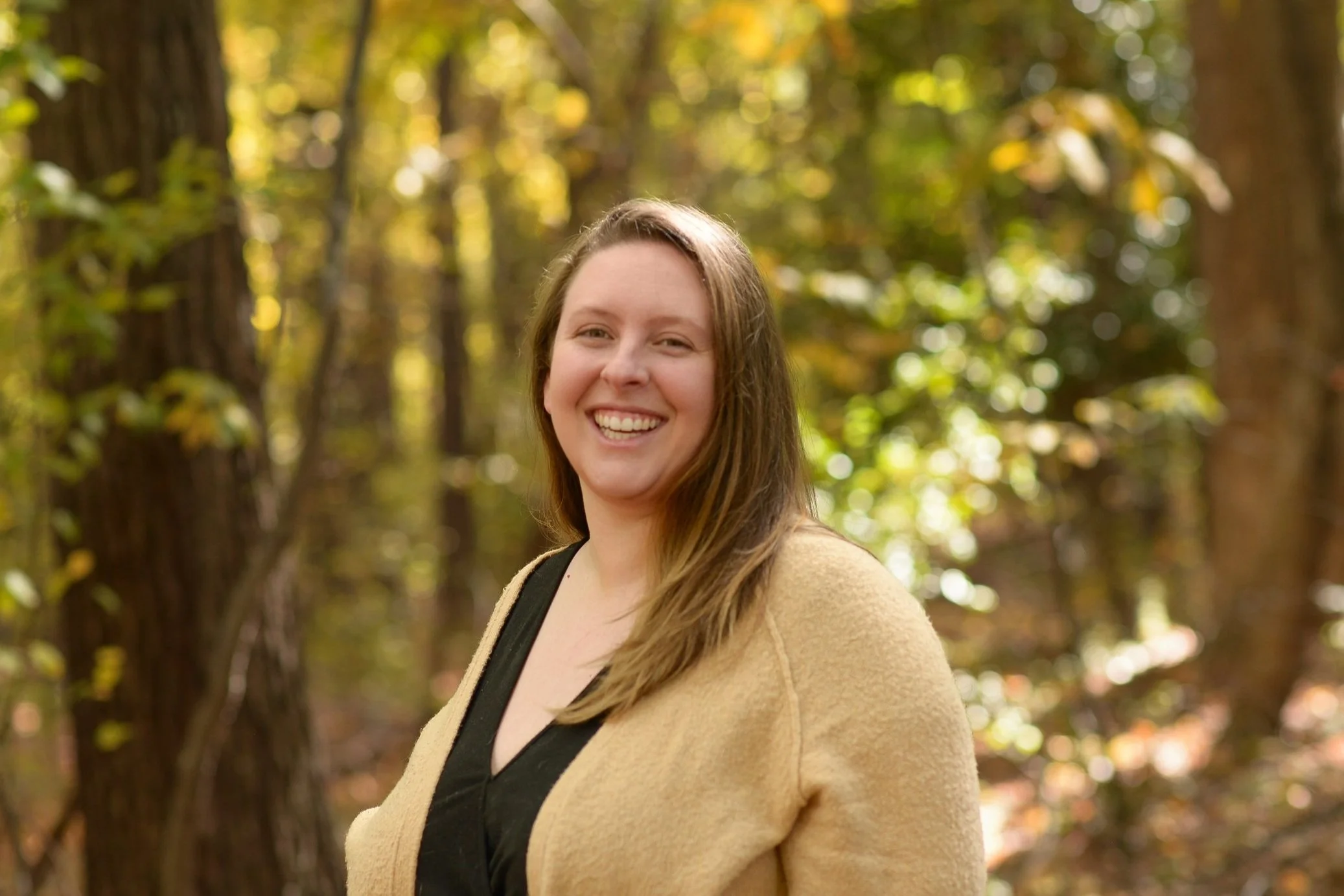
About Katie, your North Carolina Therapist
Katie Hargreaves, LCSW, LCAS, is a somatic therapist and nervous system specialist licensed in North Carolina. She has over 6 years in mental health, more than 4,000 therapy sessions, and training through Alchemy Somatics and The Embody Lab in polyvagal-informed nervous system regulation, somatic trauma processing, breathwork, and parts-based approaches.
She works with adults throughout North Carolina — including Chapel Hill, Durham, Raleigh, and beyond — via secure, HIPAA-compliant online sessions. Her practice is explicitly LGBTQIA2S+ and BIPOC affirming, and she is trained to write gender-affirming care letters.
FAQs about Anxiety Therapy in Chapel Hill, NC
-
Yes. The theoretical foundations of somatic therapy draw from several well-established research areas: Peter Levine's Somatic Experiencing, developed through studying the biology of the stress response; Stephen Porges' Polyvagal Theory, which describes the hierarchical organization of the autonomic nervous system; and Pat Ogden's Sensorimotor Psychotherapy, which integrates body-based processing with trauma theory. The broader evidence base for body-oriented psychotherapies in treating anxiety and PTSD has grown substantially over the past two decades, with multiple randomized control trials and meta-analyses supporting their efficacy compared to cognitive approaches alone.
For more details on online therapy for anxiety, explore this blog that offers an in-depth analysis of why online therapy is beneficial for anxiety.
-
I'm private pay. Sessions are $225 for 75 minutes. I provide superbills for out-of-network reimbursement, accept HSA/FSA cards, and work with Thrizer for automated out-of-network billing. We can talk through your specific situation in the consult.
-
BT works top-down — modifying cognitive appraisals to influence emotional and physiological responses. Somatic therapy works bottom-up — working directly with physiological states to influence cognitive and emotional ones. Both have strong evidence bases. For people who have done significant cognitive work and still experience somatic anxiety symptoms, the bottom-up approach often addresses what remains. The two are not mutually exclusive.
-
That's a reasonable position. The term "somatic therapy" covers a wide range of practices, some with stronger empirical support than others. What I practice is grounded in Polyvagal Theory, Somatic Experiencing, and trauma neuroscience — all of which have substantial peer-reviewed literature behind them.
If you'd like to discuss the theoretical framework or the evidence base before deciding whether to proceed, that's a legitimate thing to do in a consult call.
-
Most clients notice measurable shifts within 90 days of consistent work. Significant improvement within 2–6 months. 75-minute sessions allow enough time for actual nervous system processing within each session — which is clinically relevant, not just a scheduling preference.
-
No — I work with clients throughout North Carolina via online therapy.
Katie Hargreaves, LCSW, LCAS | Licensed in North Carolina | Online therapy statewide and in Chapel Hill, NC | hello@katiehargreavestherapy.com | 323-208-9182
Ready to stop managing anxiety and actually resolve it?
Anxiety doesn't have to be a permanent condition. When your nervous system learns safety, things change — not just how you think about anxiety, but how it lives in your body.
The first step is a free 15-minute call. No intake forms. No commitment. Just a conversation.
Areas also served: Online Therapy in North Carolina | LGBTQ+ Affirming Therapy | View our Chapel Hill Google profile